PUBLICATIONS
interview 1.
Between June and November 2025, following the exhibition Light Metals Heavy Waits at espaces flottants, Nicole Gingras interviewed Diane Morin and Sarah Rooney to discuss the ideas, encounters, and conditions that shaped their working together.
Nicole Gingras Diane Morin
Sarah Rooney
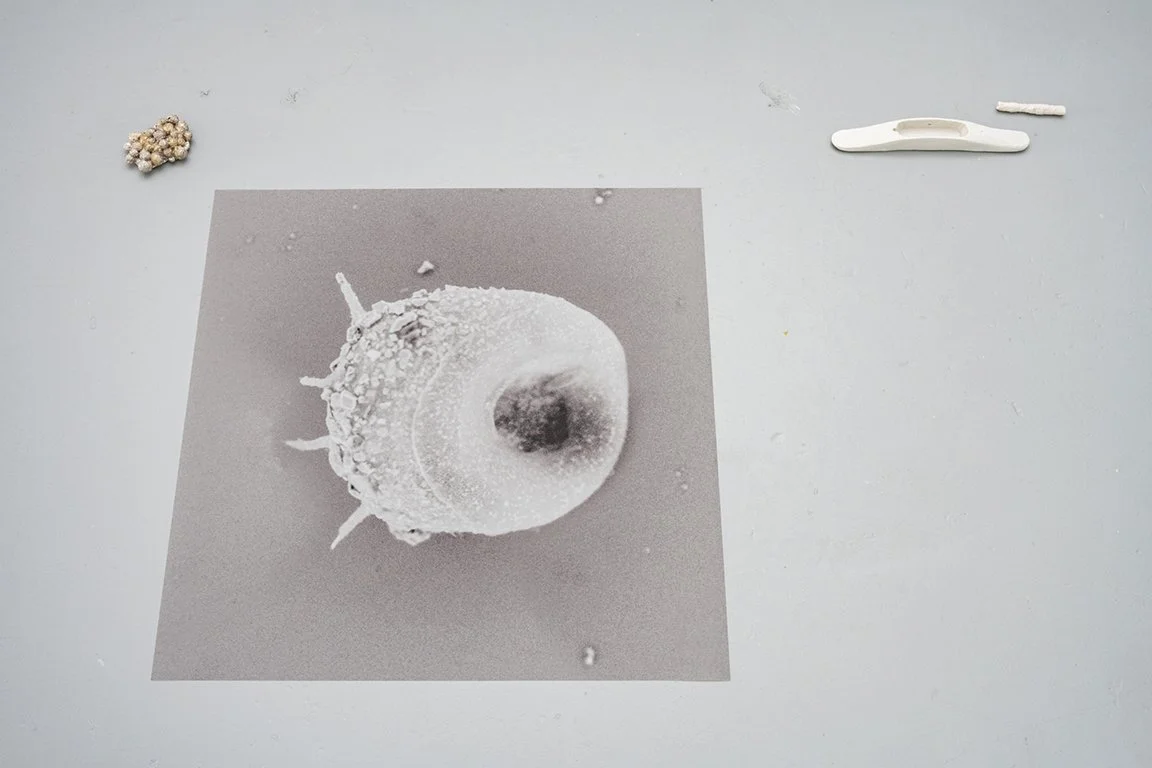
DIANE MORIN. Untitled, from the series Les sols (The Soils). 2025. inkjet print on Mylar. Untitled. pewter (bismuth and tin). Untitled. porcelain.
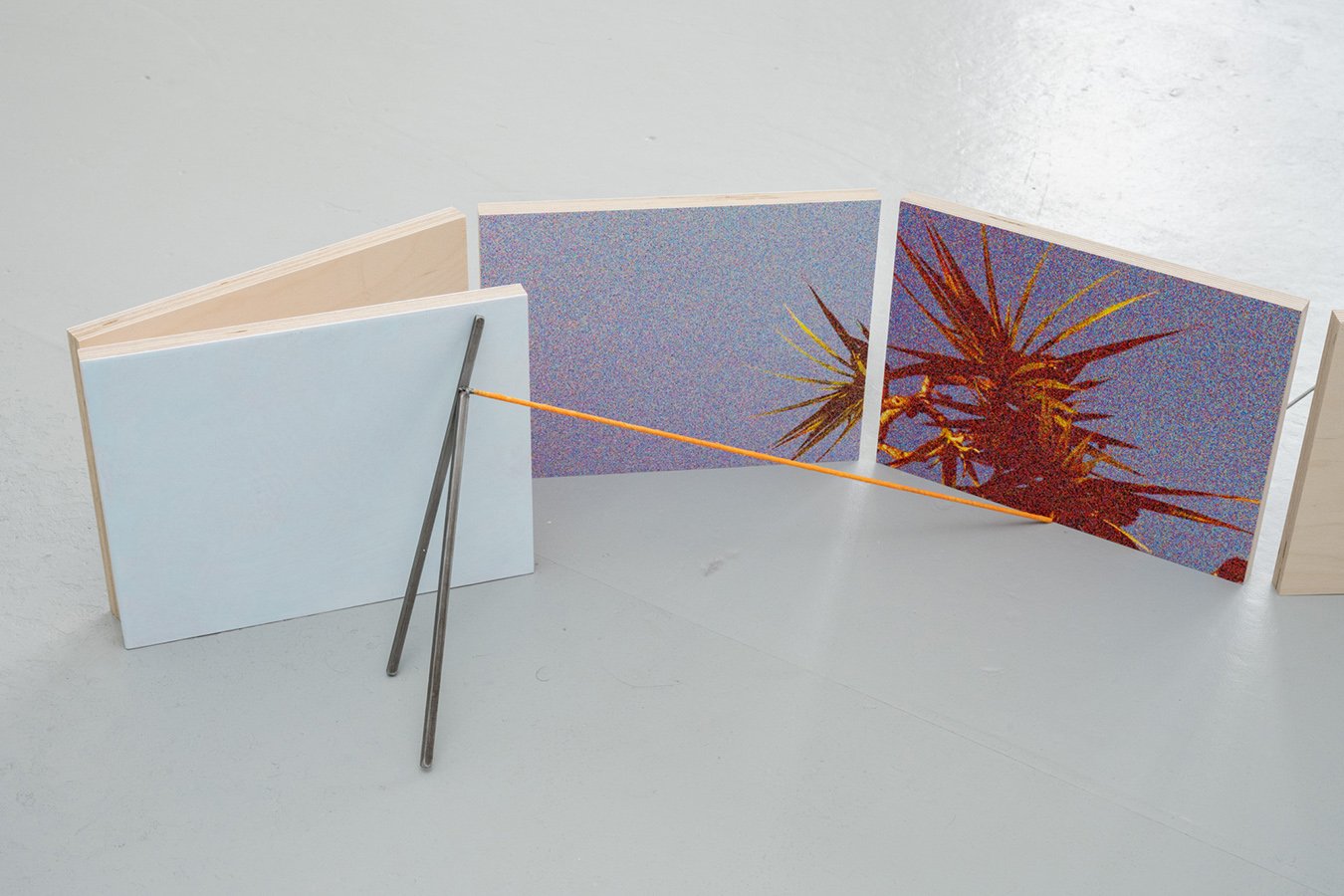
SARAH ROONEY. Stick-Creature Autobiographies. 2025. (detail). ink jet prints on Photo Rag paper, steel, paint. Documentation - Paul Litherland
Nicole Gingras – When did the idea of the two of you working together on an exhibition come about? How were the ideas of creating an exhibition space and the exhibition born?
Sarah Rooney – It was not an easy beginning. espaces flottants were born out of a rejection of existing galleries—from a lack of places to present art at a time when the number of artists selected is far too limited. It is unacceptable that there is a shortage of resonant spaces for presenting artworks in a society that values culture. These floating spaces arose out of a necessity to find alternatives places for exhibitions, so that artists can act with meaningful roles as curators of art projects—without being cataloged by a long list of words—and without being discriminated against because of their age, gender, nationality, medium, or the commercial value of their works.
espaces flottants are odes of love that artists have for their studios. They gradually came into being through chance visits, following requests to see works in the studio itself; each time, the space partially transformed into a gallery. It is surprising to realize how much my space can resemble an art gallery—a long uninterrupted wall, a floor conducive to showing various kinds of work, with the possibility of having daylight enter the room.
I wanted to launch espaces flottants around October 2024 with Périphérie aérienne - Aerial Periphery (2022–2024) to benefit from the quality of autumn light, yet fully immersed in the process of inception and becoming, espaces flottants would hold their first opening on December 14, 2024.
N.G. - Tell me about the origin of your meeting.
S. R. – I met Diane in 2020, before I knew of her work. The first encounters were either in person or during Zoom meetings. We were both teaching at the University of Ottawa, but that was the year when everything quickly moved online. In the fall of 2022, we realized that our studios were in the same Chabanel building in Montréal.
I first discovered Diane's work from online fragments. And, in December 2023, I visited the group show D'après mesures at the Galerie de l'Université de Montréal[1], where she and Ana Rewakowicz presented Et si l'in/visible, a collaborative work. Diane came to my studio a few times in the summer of 2023. I was working on Espace en biseau - Bevelling Space Sessions, which was presented at the inaugural espaces flottants exhibition. I was also developing several other projects.
In December 2023, I sketched out an idea for a group exhibition. The idea had a title and distinct lines of enquiry: The question of how to go about organizing this idea as an artist, how to work with other artists, where to show the work, the desire to collaborate with others—these intuitions and questions all fed into the evolution of espaces flottants.
Diane Morin was one of the people who I confided in about espaces flottants and who encouraged me to pursue it. At the end of the first vernissage, on December 14, 2024, Diane agreed to exhibit with espaces flottants in a near future. At the beginning of 2025, the month of May was chosen for the next exhibition, making it possible to organize a vernissage and have the exhibition run for three weeks. Mid-April/May was our most concentrated period for meeting, writing, working independently on creation, and interacting more directly with the space.
N.G. - Do you consider Light Metals Heavy Waits as two solo exhibitions or as an exhibition by two artists?
S.R.– Light Metals Heavy Waits opened on May 31 at espaces flottants as an exhibition by two artists: Diane Morin and Sarah Rooney. The exhibition was open by appointment until June 20, the summer solstice 2025. This date was extended by one day to June 21, allowing a final wave of people to view the exhibition.
N.G. - You both have strong interdisciplinary approaches. What is it about the other that particularly appeals to you?
S.R. – There are so many ways to lead into this question. When artists evolve through working with different materials, one becomes curious about how they choose their media and evolve with them over time.
In Diane’s approach, we know that she often works with electricity—DIY electronics—and initially, I was curious to know how the electronic entered her work. In her practice, I see works playing into a notion of the still-life (albeit decomposed)—the elements being looked at and the reasons for looking are within her sense of proceeding with scientific knowledge as an artist. In other recent works, I find it fascinating how her field work sometimes becomes an immersive experience in exhibition.
In Itérations, I am drawn to the way in which copper surfaces as a print-making medium and as an artwork, while in the untitled ground basin piece in the recent espaces flottants exhibition copper appears as materiality in its de-creation and formation.
Diane Morin - One of my first exchanges with Sarah was about welding and working with metal, as we were both planning to take metal-related courses—we wanted to get close to the material and explore what it can do. While I knew little of Sarah's work at the time, her explorations combining her painting practice with the presence of material elements in space immediately intrigued me. I see the elements she makes as apparatus capable of creating ambiguities about what they are.
In a more general way, I'm interested in the possibilities opened by the temporal and material gaps between reiterated elements and the “correspondences” between them through their reiterations. In Sarah's work, for me, there is a not-so-obvious form of reiteration that is going on, particularly in the relationships between the “material elements” and the images, which call and respond to each other, creating micro-narratives with the immediate space and beyond.
My interest in the notion of call and response[2]comes from performer and author Rebecca Schneider. Her texts have been with me for some time for her reflections on the notion of reiteration and for the spatial and temporal intervals she engages with. According to Schneider, the interval allows the animate and the inanimate to differentiate and co-become through each other. At a time when I'm interested in reanimating specimens from living world(s) isolated in museum collections, and when my practice is concerned with a blurring of the animate and inanimate, this encounter was invaluable. In rereading Schneider’s text intra-inanimation, just as our exhibition was coming to an end, I rediscovered a passage I'd forgotten. In it, she evokes the proximity between Roger Caillois's term mimesis to describe a relation between the stick insect and the branch and her own conception of the notion of the interval in the reiteration process.
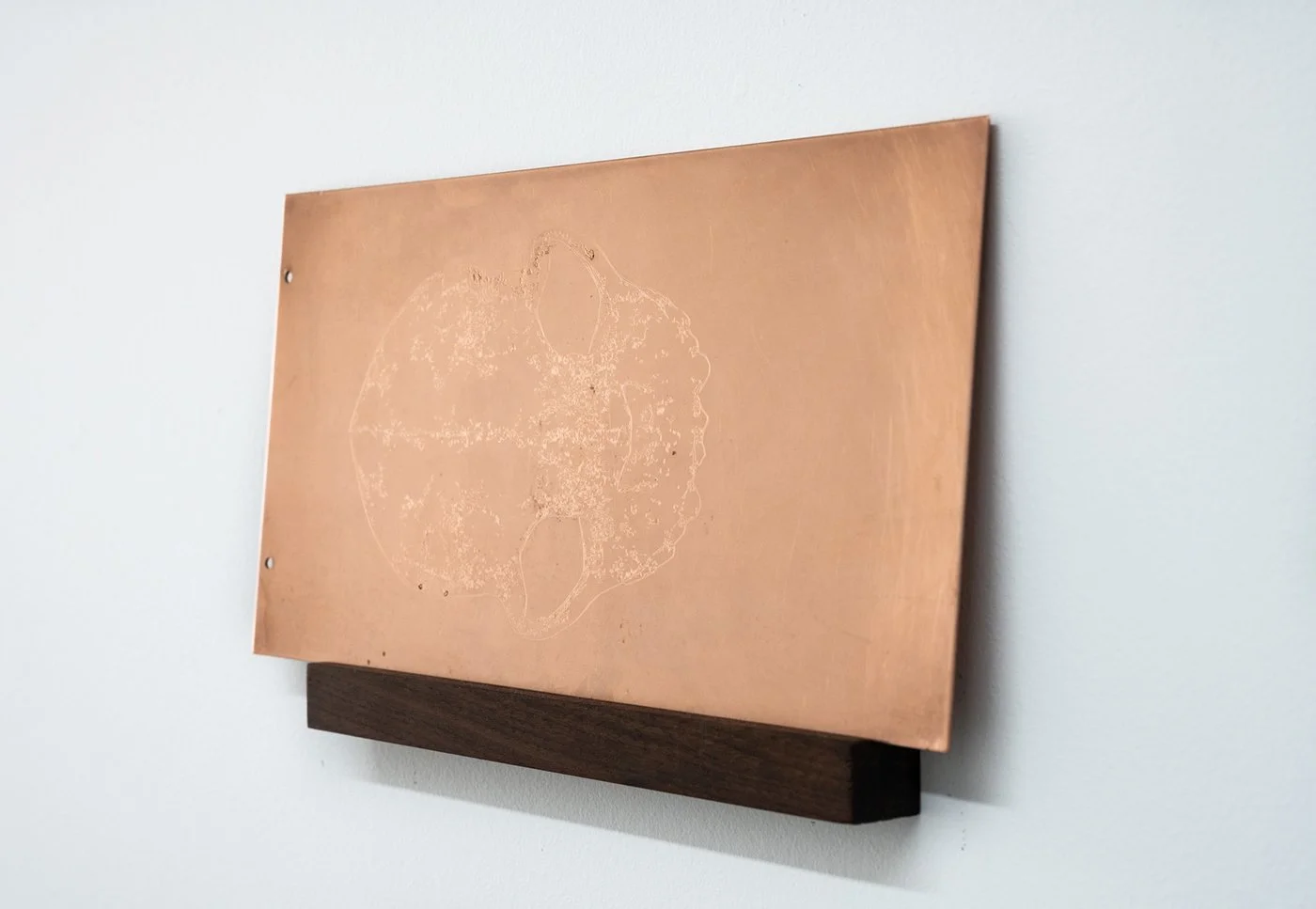
DIANE MORIN. Itérations. (detail.) 2022-2025. engraved copper plate.
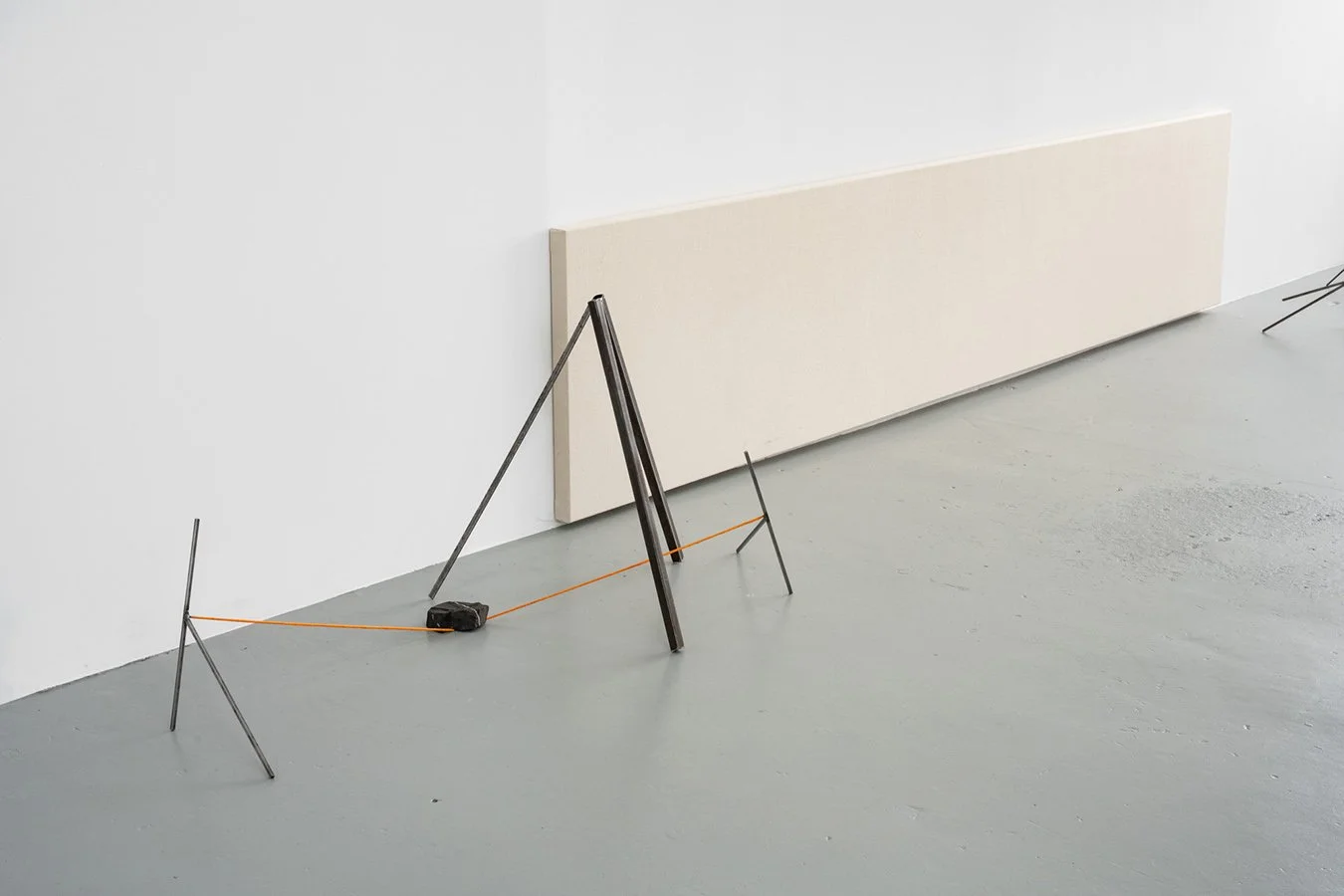
SARAH ROONEY. Soft-Interruptions. 2025. river rock, steel, wrapped painted tape.
N.G. – Sarah, you evoke the stick insect (le phasme) in your text accompanying the exhibition. We find this term in the title of one of your works exhibited at espaces flottants: Stick-Creature Autobiographies. The phénomène du phasme has been discussed by various image theorists, including Georges Didi-Huberman, who wrote a troubling and mesmerizing text on the subject. What, in particular, interests you about this insect, which is sometimes difficult to identify in nature or in its surroundings because it seems to disappear?
S.R.– In my work, the stick creature was something that opened memory and time. If I think of stick insects, I imagine nimble creatures with drawn-out proportions and a certain quietness in the negative spaces of their limbs. I can hear my grandmother and mother recounting stories of these majestic creatures, so my relationship to them also has a literary/fictive quality.
Being in contact with insects in the many cities I lived in was a daily occurrence, a lived experience, particularly in Brazil, even if I was not exactly comfortable romping around the jungle! As such, my way of meeting the stick insect differs from Didi-Huberman’s first encounter with the phasme through the vivarium. I never set out looking for the stick insect, nor was the project ever about representing or even looking at one. In hindsight, it might be that I had an experience of finding Roland Barthes’ impossible to locate punctum within one of my photographs—perhaps I cut it out and turned it into a new beginning, something that evoked the stick insect’s distinctive presence.
The texts in Phasmes. Essais sur l'apparition by Georges Didi-Huberman—a striking read—arrived late in the development of my project. Certain passages resonate, especially when they touch on differences in feelings around the phénomène du phasme and one’s relationship to what a theory of the image/object could be.
One passage particularly resonated with me:
“As if animals without tail or head could give their name to an accidental genre of knowledge and writing. A genre that might perhaps find itself situated between the crystallizing movement of the document (as a symptom of an object, emitted from reality) and the more erratic, centrifugal movement of the disparate (as a symptom of a gaze, emitted from the imaginary).”[3]
I am interested in situations that are slightly tricky, contexts that have been lost, artists/artworks that have been missed/mis-read, so yes there is a link to the phénomène du phasme in that things are not what that appear to be. However, I am also interested in the unfolding of situations or presences, which may only reveal themselves through certain modes of interacting.
I was particularly touched by Georges Didi-Huberman’s introduction in his book Phasmes. Essais sur l’apparition on the double-task of the researcher—a movement towards knowing where one is going and being open to the unknown, which we can extend to the process of making as much as viewing. In making, I do identify with the process of tricking oneself with an impossible objective so as not to predetermine the outcome or smother the potential for surprise. However, it is not the double-task, the double-life of the researcher, but the multiple-tasks, the multiple-lives woven into the problematic of making an artwork that interests me.
Before the exhibition Light Metals Heavy Waits opened, I had started writing an essay, without destination as you to say, tracing, tracing a thread between the photographic details of my inkjet prints, Stick-Creature Autobiographies (2025), the copper engravings of bat skulls in Itérations (2022) by Diane Morin, the wall installations made of woven copper (1972) by Marisa Merz, and the Empreintes de dentelle (1855) by Victor Hugo. When I opened Phasmes, I was curious to see that some of Hugo's ink works were included in Section III. Regarder of Didi-Huberman's book—a different selection from the ones I was looking at, but all made during the writer's years of exile on the island of Guernsey.
Something I sense in Didi-Huberman’s writing and the selection of works in this book was that the scary was often present—a teasing but serious read where the terrifying and the macabre manifest in both his writing and visual examples. This feels like a point of contrast between my evoking the stick creature and his writing on phasme. Given the intimate context of the exhibition Light Metals Heavy Waits, at espaces flottants, in speaking to viewers of the exhibition, one of the unexpected reactions to the work I was showing was that humour was present—maybe something new in my work is surfacing around the stick insect.
Poetry and humor are difficult to translate. The title Stick-Creature Autobiographies pertains to my photographic works on the wall that spill onto the floor as zig-zagging folded images that are accompanied by objects. My objects are made of steel and may include colour and rocks – they could be said to have stick-like-structures, but I see these objects as soft-interruptions within the space.
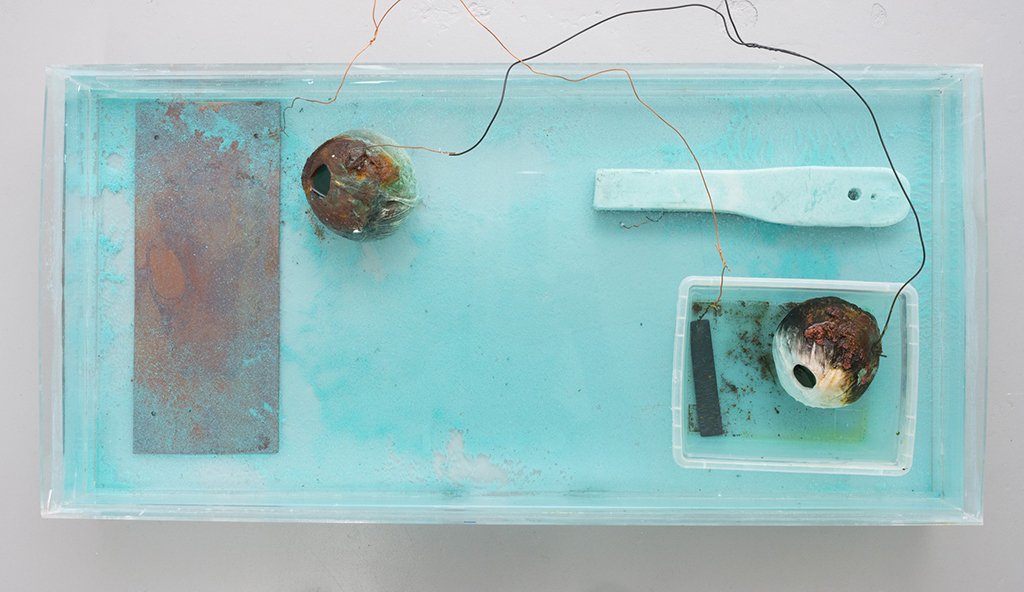
DIANE MORIN. Untitled. 20025. carbon, electricity, copper, water.
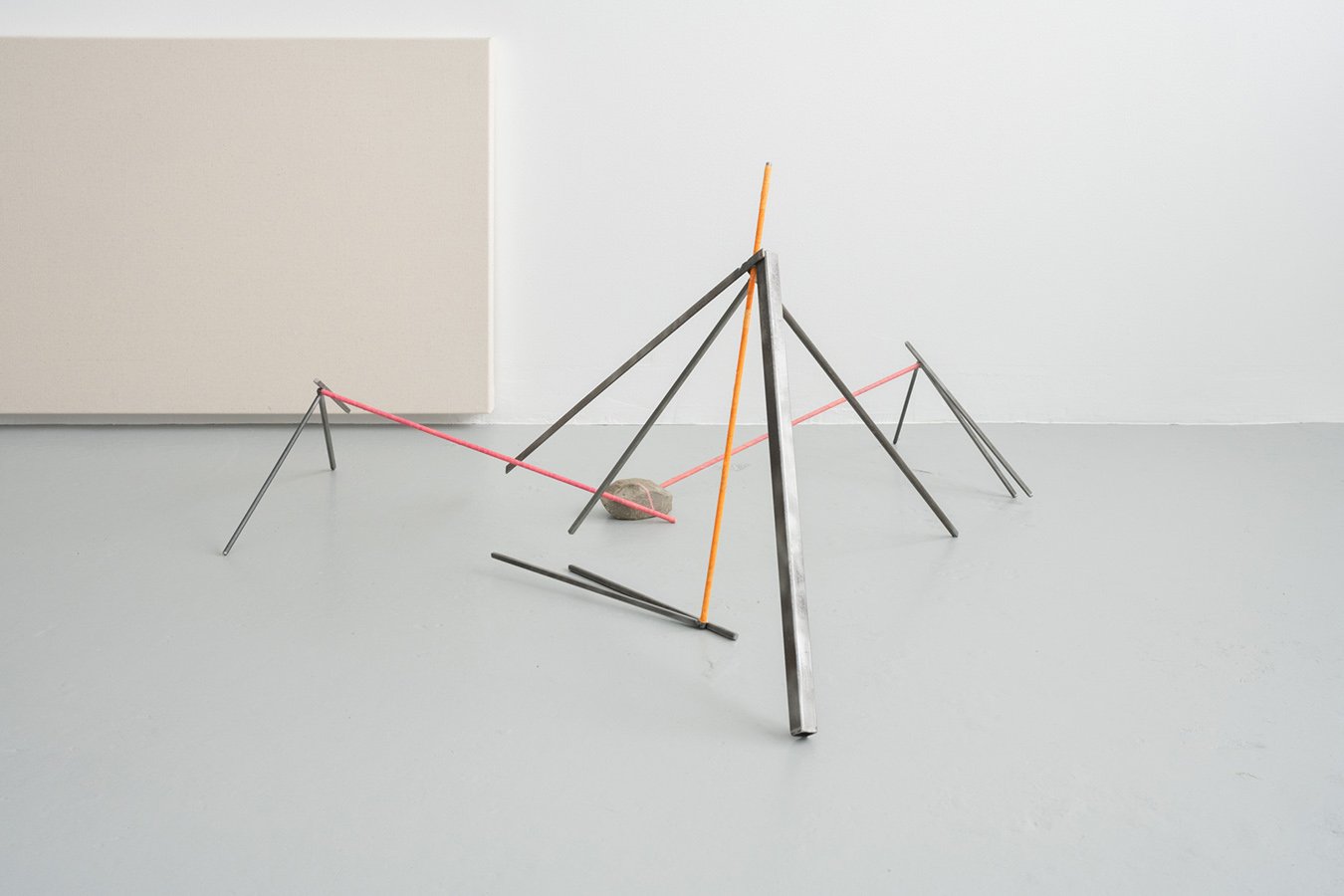
SARAH ROONEY. Soft-Interruptions. 2025. river rock, steel, wrapped painted tape.
N.G. - Diane, could you elaborate a little more on the notion of correspondence that you mentioned earlier. How is this concept particularly active in your work?
D.M. – In someways for me, the idea of correspondence echoes what I call a DIY (Do-it-yourself) practice. Initially, I used this term to name a way of working with technologies and materials to describe a way of working without necessarily having all the knowledge or the right methods to work “effectively.” Rather, to listen to what's going on, to be attentive to the little things that happen, without having a pre-established goal. I think the term DIWO[4] (Do it with others), also used by communities of people who associate themselves with DIY practices, is probably more precise; you don't do things alone, by yourself, but always because you're included in a mesh of relationships.
In my practice, I'm increasingly trying to find ways of getting close to materials in their different states. I think talking about this in terms of “correspondence” helps me think about this, while echoing what I've already called DIY or DIWO. The web of relationships I was talking about includes science and its observational instruments. It also encompasses artisanal practices; hence, my desire to introduce elements of textile craftsmanship into the exhibition. I'm also thinking of materials themselves, which have their own “becomings,” their own “practices of making.” What I mean by this is that in my explorations, I try to be attentive to the echoes that run through these practices: those of scientific observation, those of craftsmanship, and those of the “making” specific to materials.
In working with materials and technologies, I'm not looking to simply make functional devices or manipulate materials, but as much as possible to listen to them, trying to avoid prescriptive thinking and fixed ideas about how to relate to the material world. Ingold's notion of “correspondence,” not only as a written practice but also as a practice that includes the relationships we maintain with the more-than-human world, is rich for me in this sense.
How to “correspond” with other entities in becoming? How to suspend my own intentions to make room for shared becomings? How to avoid assuming that things are ‘frozen’ in fixed contours, but rather listen to their “animated” becomings? These are questions that the notion of “correspondence” helps me to formulate and explore. My recent research presented at espaces flottants with traces of microorganisms living in wetlands and objects linked to artisanal textile practices, as well as the phenomena of copper electroplating, are openings in this direction.
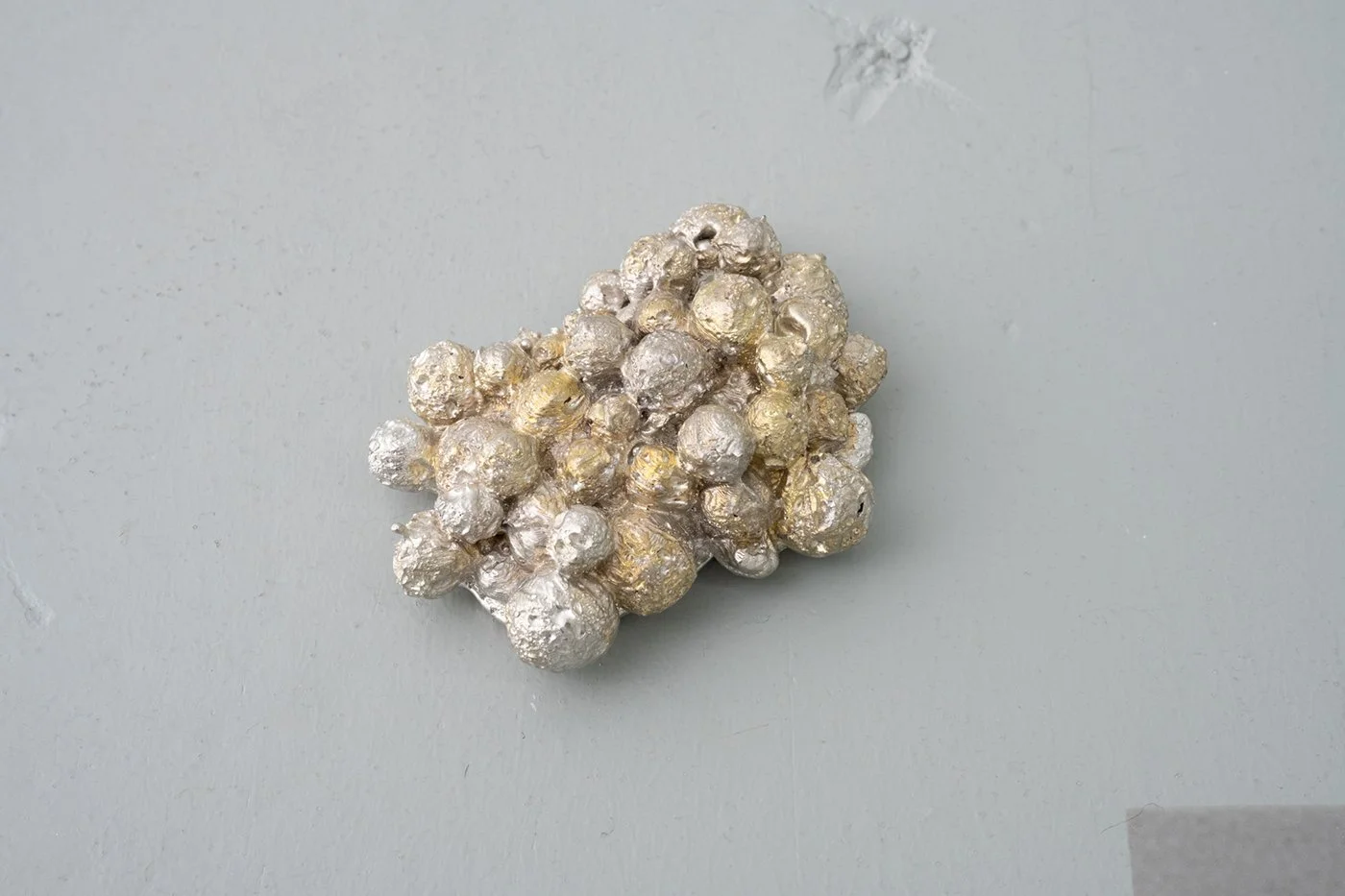
DIANE MORIN. Untitled. 2025. pewter (bismuth and tin).
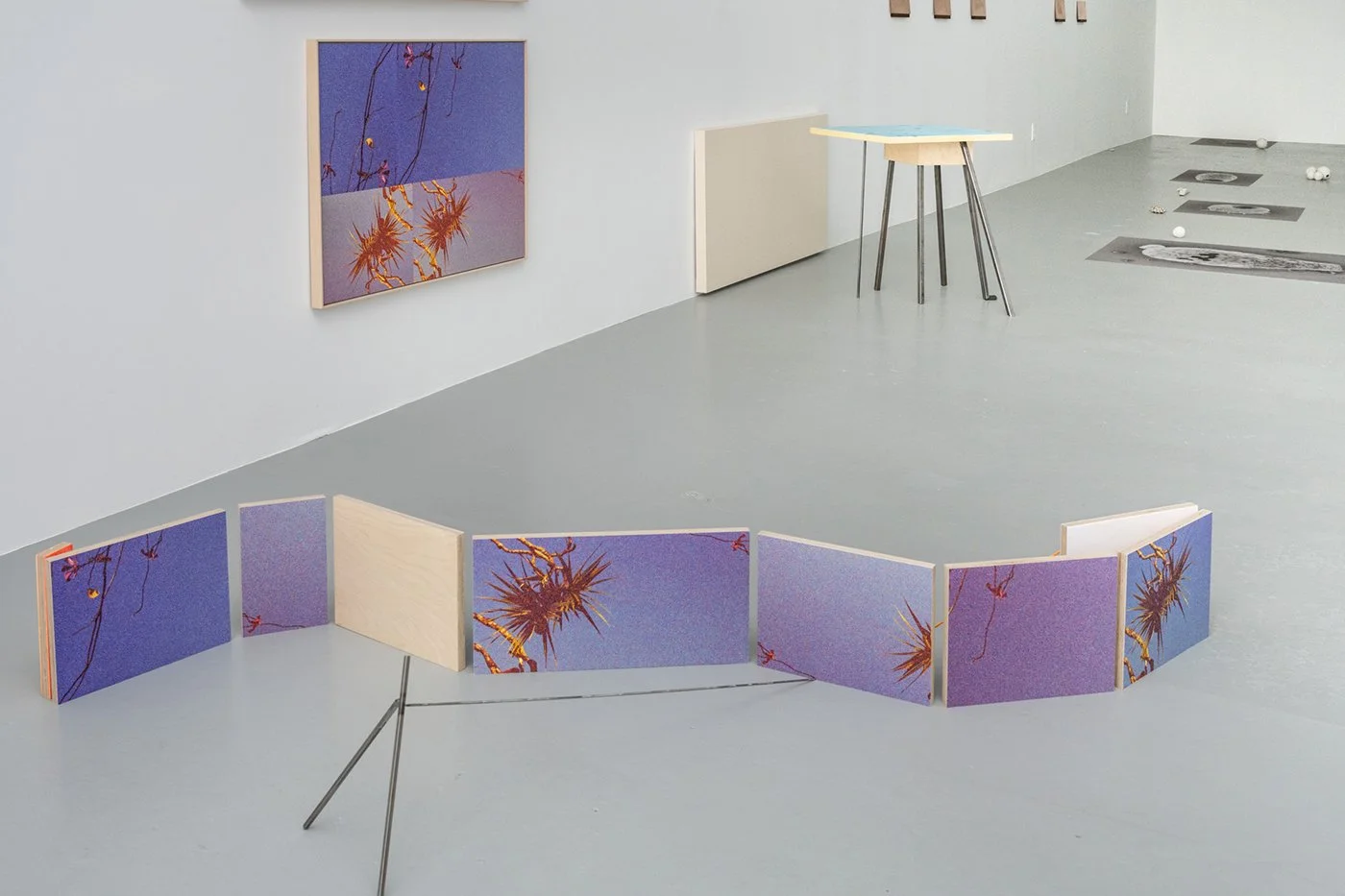
SARAH ROONEY. Light Metals Heavy Waits. 2025. exhibition view.
N.G. – Sarah, it's interesting to read how your own stick insects have crossed paths with Georges Didi-Huberman's writings. Your personal experiences, enriched by your many travels across various continents, offer a different interpretation and understanding of the phasme. I perceive a conception that is the opposite of the one articulated by Didi-Huberman. For you, the phasme is a presence that, through your experiences, takes on different forms depending on the places where you encounter it. I read them as sculptural forms, carriers of stories. It's fascinating to see how experiences and knowledge intertwine.
With regards to you, Diane, I am not surprised that Tim Ingold's ideas resonate with your current practice. In the accompanying text for the exhibition, you mention that what interests you is this: “paying attention to what things do, rather than trying to circumscribe what they are.” This crucial clarification in your practice, in my opinion, favors the act of “making” instead of “being.” And “making” leads us to “becoming” because in making, there is a question of the present and its transformation, or the traces of this present in transformation. This brings us back to Tim Ingold. In Being Alive – Essays on movement, knowledge and description, he writes and shares this succinct and revealing idea: “Things are their relations.”[5] This short sentence seems appropriate to both your works and your approaches. Could you comment on this?
D.M.– In Correspondences, Ingold also tells us that the stones, the trees, and the mountains do not exist in isolation or independently. Encountering them is rather an event that would include us, in something that happens: a process in which we perceive them as a “going-on that spills out into its surroundings.” He suggests that to name them, it might be more accurate to use verbs instead of nouns such as “to stone,” “to tree,” “to mountain,” and even “to humanize.”[6]Rather than confining things to predefined categories, this would help us to inhabit a world where undefined matter is constantly in the process of differentiating itself.
Another author who interests me in relation to the notions of becoming and being is Alexander Galloway. In his text Golden Age of Analog, he considers the notion of event first in an “analogical” way, based on relations—which create similarities—and then in a “digital” way, based on decisions, which create differentiations. An “analog event” would thus be a relation, indifference, continuity, and similarity, while a “digital event” would be decision, distinction, rupture, and difference. These distinctions certainly need to be blurred, but they help me to think of an event that would be both relation and decision, or perhaps to envisage one that would be neither: removed from decision, removed from becoming. These reflections have been with me for some time, insofar as I perceive my material explorations with analog and digital technologies as ways of thinking about our relations to the material world(s).
I believe that according to Ingold's thinking, at least as I understand it, matter is initially undifferentiated, constantly in transformation and in relation. Corresponding with things would therefore imply appreciating that things are also the history of their differentiations, of their “becoming-other” than themselves, as reflected in this quote: “The story of a stone, a tree, or a mountain, like the story of a human being, is also the story of those things or beings that, over time, become other to it: the moss, the birds, mountaineers.”[7]
One thing that any work of art can do, it seems to me—whether it be Sarah's work or my own—is not to represent these processes of animated matter, but to reveal them, to make them more perceptible to us. And I try to do that, I think, through reiterations and “withdrawals,” through moments of temporary stabilization and ambiguity.
S.R.– “Things are their relations.”
That painting is physical is important to me. This does not mean that I am concerned about texture. The painting could be made of layers that are so thin that we forget that those layers are 3-dimensional. How these thin layers of paint are built by the hand and how I experience them keeps me returning to painting as one of the languages I work through.
I first encountered Diane’s Itérations through a fragment online. The photograph was taken at an angle—a view onto the side of the work and wall, revealing the physicality and the warmth of the copperplate engravings. The image traces on the soft metal appeared to be of organic matter, with the engraving evoking lacy imprints held within the metal surface.
Itérations was installed at espaces flottants in a grid pattern—a broad glowing field. Standing head on, the metallic surfaces reflect light in the space, but to see the engravings, which were created from scans of bat skulls, one must move. Through movement, the idiosyncrasies of the markings become visible.
Itérations shared the wall with Stick Creature Autobiographies. The physicality of paint is not present in the latter, but the traces of photographic imaging and colour are accentuated by being printed on photo-rag paper, whose surface holds hypnotic-grain (infinity particles) allowing colour to burst into the room. It is in space that the copper plates in Itérations and colour fields in Autobiographies des phasmes come into relation.
The phénomène du phasme continues to surface in the exhibition space. Depending on the time of day, the light coming in from the window can hide the works on the floor. If they are backlit, they are caste in glare or clarity depending on the weather. Looking away from the window into the space of the installation presents a very different reading of works and their inter-relationality.
Lying directly on the floor at the entrance to exhibition space are recent grey-scale prints and objects by Diane Morin. The images are sourced from microscopic views of testate amoebae shells brought into relation with caste objects. The radical shift in scale of the enlarged photographic sources raises awareness of the micro/macro element that permeates both artists’ works.
Without talking in detail about what Diane’s testate amoebae shells look like, they seem to conjure clear associations despite their abstract qualities; for example, in one of the images one might see grains of rice frozen in time or a porcelain vase. However, towards the edges, the images become more ambiguous like eye floaters. I am drawn to how we form relations with ambiguities that we can relate to and how we build relations with ambiguities that we don’t recognize.
My new sculptures, Soft Interruptions, are works with a relational direction, but within the relational is another tension, a pulling. The rocks and steel rods pull relationally, but the elastic-colour-rods pull with tension.
In Light Metals Heavy Waits, two artists come together at a time when there is a circulation between works that we are each making right now and works that are being made over several years (and beyond, if we consider the traces left by the organisms made visible here, or the rocks present in the installation). The works exhibited at espaces flottants are experimental—there is a force in latency—like soft metals, there is a bending of the body and a coexistence in their interrelationships. Instead of a potential chasm, I see a relational movement between the visitor and the works, and between the works themselves.
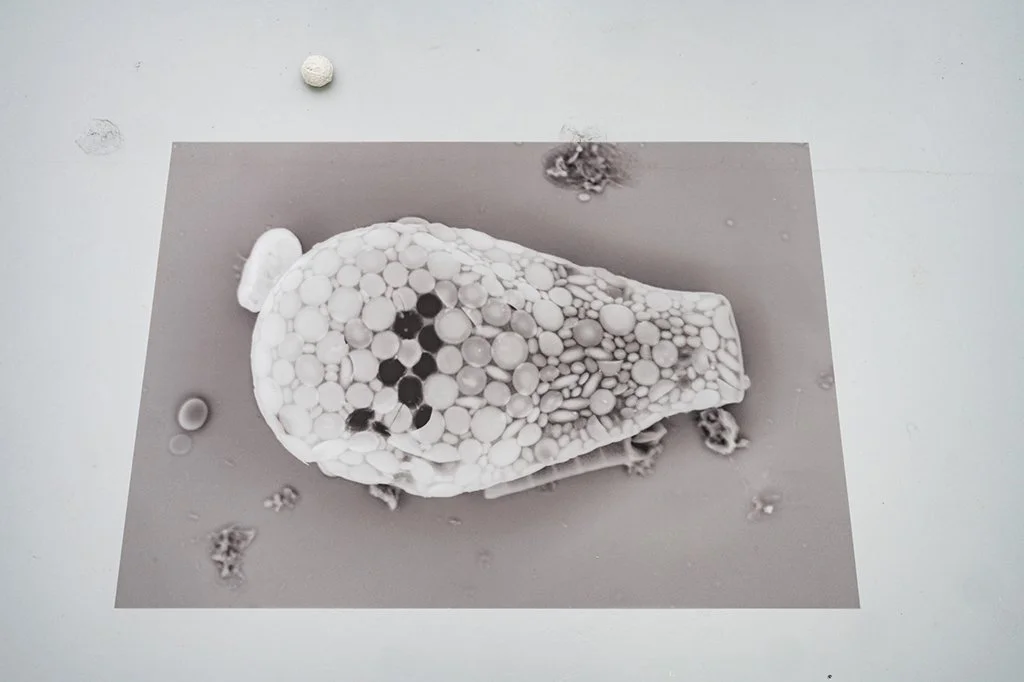
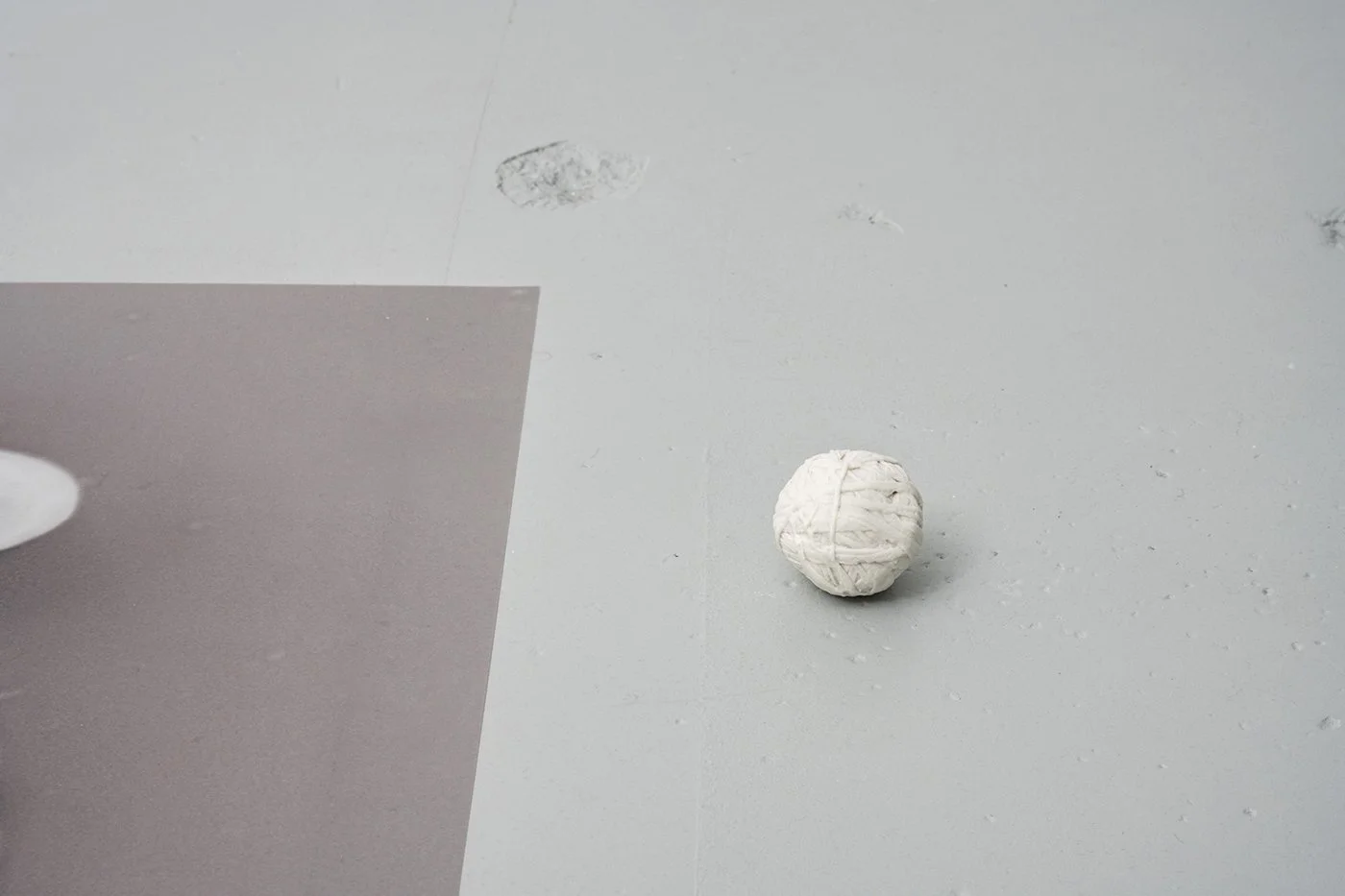
DIANE MORIN. Untitled, from the series Les sols (The Soils). 2025. inkjet print on Mylar. Untitled. porcelain. 2025.
N.G. – When you think back on the experience you had while preparing Light Metals Heavy Waits at espaces flottants, what image or feeling comes to mind now that time has passed and your works have returned to your studio?
S.R. – I cannot imagine art without studio-based practices, and in the same breath I can ask: Where is art thought out, where is it made, and where is it shown? Where does the studio begin and end?
I am deeply grateful for the warm reception of the exhibition Light Metals Heavy Waits at espaces flottants, and for the opportunity to realize this idea by presenting the works of Diane Morin and myself side by side. I would like to see the emergence of new ways of engaging art—approaches that reimagine spatial resources and uncover the hidden richness of artists within the city and beyond in unexpected ways.
I have been thinking about residency programs away from home, and yet I am drawn to the concept of the auto-residency—a model that does not enter the politics of asking for permission so that an artwork can be allowed to exist. This format was in part brought to light during (and following) the experience of the pandemic with established artist-run centres announcing continued auto-residencies in their calls for applications. This move, while not without challenges, validates the concept of self-defining artistic paradigms and acknowledges the lack of financing, affordable real estate, and support teams—all key components needed for exhibition building.
D.M. – I think of the light in the space that accompanied the development of the project, changing with the seasons. I think of the presence of colours—often discreet in my works but suddenly more noticeable. I think of the different “zones” that echoed and met each other—the works, of course, but also the ceiling, floor, walls, and windows that let light and space in from outside. I think of the discreet importance of the “remnants” of the building's past life, which helped to animate the exhibition.
I would say that I am left with a feeling of tangible clarity: a moment, a specific place in which certain things became clear for a fleeting moment. Over the past year, the art projects I was working on in my studio were somewhat chaotic and difficult to grasp, somehow indeterminate. The exhibition with Sarah allowed for the crystallization of intuitions, making them more perceptible. It allowed me to isolate certain fragments and beginnings of works that we chose together during our exchange, and to give them a place to exist in a context of encounter with other fragments—the elements of the space, Sarah's works—and with an audience.
I also think about the question of collaboration and how things fell into place. Letting things emerge, in the encounter. Being in both the background and in the action. What I take away from the collaboration also sheds light on what I try to do with materials in the studio—not deciding everything, letting what is other animate me.
End notes
[1] D’après mesures, group exhibition, curated by Anne-Marie Belley, Galerie de l’Université de Montréal, 2023.
[2] Rebecca Schneider, “Intra-inanimate,” in Animism in Art and Performance, edited by Christopher Braddock, London, Palgrave Macmillan, 2017, p. 162
[3] Georges Didi-Huberman, Apparaissant, disparate, Phasmes. Essais sur l’apparition, Paris, Les éditions de Minuit, 1998, p.11.
[4] The term was first defined in 2006 through the online project Rosalind: Upstart New Media Art Lexicon.
[5] Tim Ingold, Being Alive - Essays on movement, knowledge and description, Routledge, 2011, p. 70.
[6] Tim Ingold, Correspondences, Polity Press, p. 7.
[7] Tim Ingold, Correspondences, Polity Press, p. 7.
Editorial support - Louise Ashcroft
Documentation - Paul Litherland

Light Metals Heavy Waits. espaces flottants, Montreal, 2025 DIANE MORIN & SARAH ROONEY.
Biographies
Nicole Gingras is a curator, writer, and publisher. Creative processes, along with the concepts of time, listening, traces, and the imaginaire, inform her work.
Diane Morin creates installations that reenact apparatus from the past of sciences and explore relationships between/with physical and experiential phenomena.
Sarah Rooney makes paintings and image‑objects in space. Her approach often mobilizes underpainting not as an initial ground but as a porous mode of thinking with.
For more images + information about the exhibition: Light Metals Heavy Waits